
Your Prenatal Is NOT the Place to Cut Corners. Sorry, Not Sorry.
Oct 22, 2026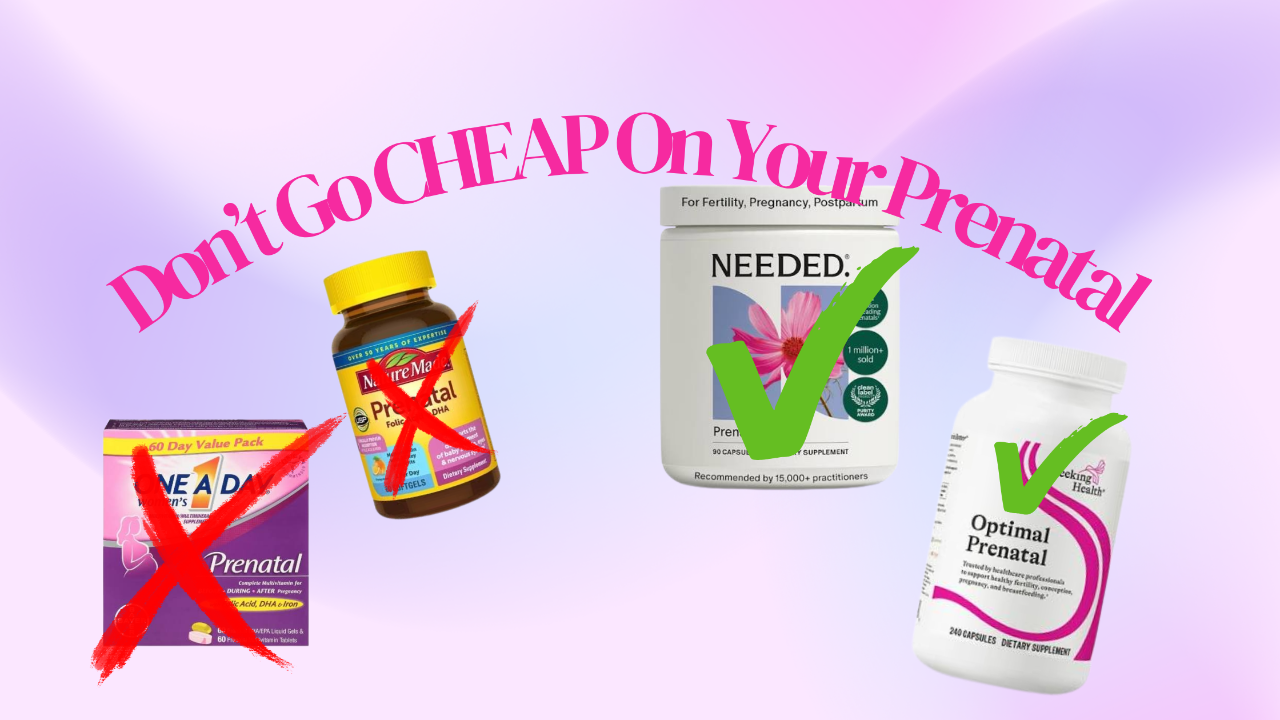
Why your prenatal matters, what I actually look for in a quality formula, and the brands I recommend.
Mama, we need to talk about prenatal vitamins, because this is one area where I really don't want women cutting corners.
I'm going to say something that might ruffle a few feathers: some of those one-a-day prenatals lining the grocery store shelves are garbage. Sorry, not sorry. 🤷♀️
Now, before someone comes for me, I'm not saying every single one-a-day prenatal is worthless. What I'm saying is that a lot of these formulas are marketed as complete prenatal nutrition when they're missing important nutrients, contain barely meaningful amounts of others, or combine ingredients in ways that aren't necessarily ideal for absorption.
And when we're talking about the nutritional demands of growing an actual human being, I think we should be asking a few more questions than, "Does this bottle say prenatal?"
Pregnancy is one of the most nutritionally demanding seasons of a woman's life. Your body is expanding blood volume, supporting placental development, adapting its metabolism, and supplying nutrients for your baby's rapidly developing brain, nervous system, organs, and tissues. Those processes depend on adequate nutrition, and they begin much earlier than most women realize.
This is also why I'm such a big believer in preparing nutritionally before pregnancy whenever possible. The early stages of fetal development happen before many women even know they're pregnant, which makes preconception nutrition incredibly valuable.
And yes, real food will always be my foundation. But even a woman who eats a beautiful, nutrient-dense diet can have gaps during pregnancy. A well-formulated prenatal is meant to help fill those gaps, not replace the importance of eating well.
What Should Actually Be in a Quality Prenatal?
This is where I want women to become label readers instead of marketing readers.
A quality prenatal should provide thoughtful nutrient forms, meaningful amounts of key vitamins and minerals, and enough flexibility to account for individual needs. My training places particular emphasis on folate and B-vitamin forms, choline, comprehensive mineral support, and the ability to customize iron rather than forcing every woman into the exact same dose.
Here are some of the key daily nutrient requirements during pregnancy for women ages 19–50. Remember, these are total daily intake targets from food and supplements combined, not amounts that must all come from one prenatal.
| Nutrient | Daily pregnancy intake |
|---|---|
| Folate | 600 mcg DFE |
| Choline | 450 mg |
| Iron | 27 mg |
| Iodine | 220 mcg |
| Magnesium | 350–360 mg |
| Zinc | 11 mg |
| Selenium | 60 mcg |
| Vitamin B12 | 2.6 mcg |
| Vitamin B6 | 1.9 mg |
| Calcium | 1,000 mg |
| Vitamin D | 600 IU (15 mcg) |
Those numbers give us a starting point, but they don't tell the entire story. The form of a nutrient, how it interacts with other nutrients, dietary intake, and an individual's laboratory findings all matter.
Folate and B Vitamins: Form Matters
Folate is critical for DNA synthesis, cell division, and early neural tube development. It's one of the biggest reasons I encourage women to begin prenatal nutrition before conception rather than waiting for a positive pregnancy test.
When evaluating formulas, I also pay attention to the forms of B vitamins being used. You'll see quality prenatals containing methylfolate or folinic acid, vitamin B6 as P5P, and forms of B12 such as methylcobalamin, hydroxocobalamin, or adenosylcobalamin.
These forms are worth understanding because different women may tolerate them differently. My course work emphasizes that women who don't do well with highly methylated supplements may benefit from formulas offering alternative active B-vitamin forms.
The goal is to choose a well-formulated product that meets your needs, rather than assuming the most expensive or trendiest ingredient must be the best.
Choline: One of the Biggest Gaps I See
If you've followed Lily Nichols and her work on real-food pregnancy nutrition, you know that choline deserves a lot more attention than it gets.
Lily has done an excellent job bringing awareness to the nutritional importance of foods like eggs and other animal-based foods during pregnancy, and I appreciate her emphasis on understanding nutrients in the context of real food rather than looking at supplements in isolation.
Choline is especially important for fetal brain development, cell membrane structure, and methylation. Pregnancy increases the recommended intake to 450 mg daily, yet many prenatal vitamins contain very little choline—or none at all.
This is one reason I like more comprehensive prenatal formulas. My course notes suggest looking for at least 150–200 mg of choline in a prenatal as a meaningful contribution, with the remainder coming from food or additional supplementation when appropriate.
Egg yolks are one of my favorite food sources, but the bigger point is that you need to know how much choline you're actually getting. A prenatal with 50 mg and one with 250 mg are not providing the same level of support.
Iron: Why I Prefer It SEPARATE From the Prenatal
This is one of the biggest things I look for when selecting a prenatal, and it's something most women have never been taught.
I actually prefer a prenatal that allows iron to be taken separately.
Here's why.
Iron is essential during pregnancy because maternal blood volume expands significantly, increasing the demand for hemoglobin and oxygen transport. But iron absorption is influenced by what you take alongside it, and calcium can interfere with iron absorption when consumed together.
The research on how much this matters over the long term is mixed, but separating iron from calcium-containing supplements is a practical strategy I prefer.
Many prenatals contain both nutrients together. A more flexible approach is to choose a comprehensive prenatal without iron and, when iron supplementation is needed, take an appropriate iron supplement separately, away from calcium.
That also allows us to customize the iron dose based on the woman's actual needs.
And this is a BIG deal because not every pregnant woman starts with the same iron status. One woman may have depleted iron stores and need additional support, while another may already have adequate or elevated iron markers.
I don't love the idea of blindly stacking iron supplements without understanding the bigger picture.
When evaluating iron status, I like looking beyond hemoglobin alone and considering ferritin and other iron markers when clinically appropriate. A woman can have changing iron stores before those changes are obvious on a basic CBC.
If additional iron is indicated, I generally prefer a well-tolerated form such as iron bisglycinate, taken separately from calcium supplements, coffee, and tea. The exact amount should be coordinated with her prenatal provider because iron needs and pregnancy treatment protocols vary.
A prenatal without iron is not necessarily an incomplete prenatal. Sometimes it's a more intentional formula that gives us the flexibility to address iron properly.
The key is making sure iron needs are actually being met, rather than assuming that leaving it out is automatically better for everyone.
Magnesium, Zinc, Selenium, and Iodine: Don't Forget the Minerals
One of my frustrations with basic prenatals is how heavily they focus on vitamins while giving very little attention to comprehensive mineral support.
Magnesium is needed in hundreds of biochemical reactions involving energy production, protein synthesis, muscle and nerve function, and normal glucose regulation. Zinc supports growth, DNA synthesis, and immune function, while iodine and selenium contribute to normal thyroid physiology.
During pregnancy, these systems are working hard, and adequate mineral intake matters.
I emphasize looking for meaningful amounts of magnesium in a prenatal, with around 200-300 mg being a useful contribution when the remainder is coming from food or other appropriate sources. I also prefer well-tolerated forms such as magnesium glycinate or malate rather than assuming every magnesium compound is interchangeable.
This doesn't mean we should supplement every mineral aggressively. Iodine and selenium are perfect examples of nutrients where adequate intake matters, but excessive intake can create problems.
We're aiming for nutritional sufficiency, not megadosing.
Vitamin D: Why I Don't Believe More Is Always Better
Now THIS is a topic I have a lot of opinions on, because vitamin D is one of those nutrients that gets oversimplified constantly.
Someone gets bloodwork, their vitamin D comes back low, and the immediate response is often to start taking thousands and thousands of IUs.
But I want to know WHY it's low.
Vitamin D isn't just another vitamin. It's involved in complex hormonal and mineral-regulating pathways, and its metabolism depends on several other systems functioning appropriately.
The most commonly tested marker is 25-hydroxy vitamin D, or 25(OH)D. This is useful for assessing vitamin D status, but it doesn't tell us everything about vitamin D physiology.
There's also 1,25-dihydroxy vitamin D, the hormonally active form, which is tightly regulated and answers a different clinical question. It is not a routine replacement for 25(OH)D testing.
Vitamin D physiology also interacts with magnesium, calcium, parathyroid hormone (PTH), kidney function, and other factors.
For example, magnesium is involved in vitamin D metabolism. If someone's magnesium status is inadequate, simply increasing vitamin D without addressing the broader nutritional picture may miss an important piece.
And PTH can sometimes provide useful context when calcium or vitamin D regulation is unclear.
This is why I don't love the approach of randomly adding high-dose vitamin D to everyone's routine.
More vitamin D is not automatically better vitamin D support.
A modest amount of vitamin D in a prenatal can be perfectly reasonable, and some women will need additional supplementation. But I want that decision to be informed by dietary intake, current supplements, relevant labs, and medical context rather than treating high doses as a universal pregnancy recommendation.
I also don't believe every pregnant woman needs an extensive vitamin D panel. Additional testing, including PTH or active vitamin D, should be selected when there's a specific clinical reason.
The goal is to support normal vitamin D physiology without blindly chasing a number or creating unnecessary excess.
And yes, vitamin D toxicity is a real concern because excessive intake can lead to high calcium levels and other complications.
So when you're comparing prenatal formulas, please don't automatically assume the one with the most vitamin D is the best one.
Don't Forget DHA
Another nutrient worth discussing is DHA, an omega-3 fatty acid that plays an important role in fetal brain and retinal development.
Lily Nichols' real-food approach is especially helpful here because it encourages women to consider the nutritional value of appropriately selected fish and other nutrient-dense foods rather than relying entirely on supplements.
I emphasize omega-3 intake as part of comprehensive prenatal nutrition, with particular attention to adequate DHA.
Many prenatal multivitamins don't contain DHA at all, which means women may need to obtain it through low-mercury seafood or a separate omega-3 supplement.
A commonly used minimum target is approximately 200 mg of DHA daily, although individual recommendations can differ.
The important thing is to look at the whole nutritional picture rather than expecting a multivitamin to cover absolutely everything.
My Favorite Prenatal Brands: Needed and Seeking Health
After all of that, you're probably wondering which prenatals I actually like.
Two of my favorites are Needed and Seeking Health.
I appreciate that both brands offer thoughtfully formulated options with attention to nutrient forms and meaningful amounts of nutrients that are often overlooked in basic prenatals.
Needed
Needed offers more comprehensive multi-capsule formulas, and I appreciate that their approach recognizes that meaningful nutrient amounts take up space.
Sometimes a more comprehensive prenatal simply requires more capsules. That's not automatically a downside if it means you're getting a broader range of nutrients.
But here's where I really appreciate having options: pregnancy nausea is REAL.
If you're in your first trimester and swallowing a handful of capsules makes you gag, Needed also offers a vanilla prenatal powder that can be mixed into a smoothie.
The powder isn't identical to their more comprehensive capsule formula, so the nutrient amounts should be compared, but it's a practical alternative for women who struggle with capsules.
Needed also has a prenatal gummy option.
Now, let's be clear: gummies generally aren't going to provide the same mineral density as a comprehensive multi-capsule prenatal. There's only so much you can fit into a gummy, and some nutrients may need to be addressed separately.
But if you're in the thick of first-trimester nausea and cannot tolerate capsules, a suitable gummy can be a much better temporary option than skipping prenatal support altogether.
Just make sure you're aware of what it does and doesn't contain, especially when it comes to iron and other nutrients that may need separate attention.
Seeking Health
Seeking Health is another brand I really like because they offer comprehensive prenatal options, including formulas with different B-vitamin forms.
That flexibility can be helpful for women who don't tolerate certain methylated supplements particularly well.
Some of their prenatal formulas also leave iron out, which aligns with my preference for addressing iron separately when needed.
As always, the exact formula matters. I don't recommend choosing a supplement based on the brand name alone without checking the specific nutrient amounts.
Before you freak out - I get it.
Look, I know you. 😂 You want the easy one. And listen, I GET IT. Nobody wakes up excited to swallow a handful of capsules every day. But there's a reason I titled this article the way I did!
When we prioritize convenience, fewer pills, or saving a few bucks over getting meaningful amounts of the nutrients our bodies need during pregnancy, we may be making a bigger sacrifice than we realize.
And before you roll your eyes at my top prenatal recommendations because they require "too many pills," hear me out. Four in the morning, four in the evening. I KNOW it sounds like a lot, but suck it up, mama. Respectfully. 😉❤️
If swallowing capsules genuinely isn't an option, that's exactly why I mentioned the powder and gummy alternatives above. There are options, and something you can consistently tolerate is always better than a supplement you can't keep down!
The good news is that a comprehensive prenatal covers a LOT of nutritional ground, so you may not need to add much else unless you have specific needs.
And I'm right there with you! I'm actually pregnant with baby #4 as I write this, and I take my Needed prenatal daily. I also take additional magnesium because my RBC magnesium levels showed I needed extra support, and I sometimes take cod liver oil as well. That's my personal routine, not a blanket recommendation for everyone.
So yes, it's a few extra capsules. But it's manageable, it's temporary, and for me, the nutritional coverage is worth it.
You got this, mama. 🤍
The Bottom Line: Quality Matters, but So Does Individualization
I don't expect every pregnant woman to have a perfect diet, take a dozen supplements, or spend a fortune on the most expensive prenatal available.
But I do want women to understand that prenatal nutrition deserves more thought than grabbing the first bottle they see at Target.
Look at the forms of nutrients being used, the actual amounts, whether important minerals and choline are included, and whether the formula gives you flexibility around nutrients like iron and vitamin D.
Most importantly, remember that your prenatal should complement a nutrient-dense diet and your individual needs—not replace either one.
Growing a human is a big deal. This is not the place I want you cutting corners.
Shop My Favorite Prenatals
If you're overwhelmed by all the options, I've already done some of the homework for you!
I've put together a prenatal recommendation list through Fullscript featuring some of my favorite quality supplement options, including Needed and Seeking Health.
Fullscript is my favorite place to shop for professional-grade supplements online because I value knowing where products are coming from and having access to trusted supplement brands.
You can shop through my practitioner link, and there's a discount available when you sign up!
Shop My Prenatal Recommendations on Fullscript
Because you and your baby deserve thoughtful, quality nutrition. 🤍
This article is for education and is not individualized medical advice. Pregnancy-related supplementation, laboratory interpretation, and treatment decisions should be coordinated with a licensed prenatal healthcare provider.
Ready to stop piecing it all together yourself?
Whether you're looking for answers in your bloodwork or need a realistic nutrition plan that fits your life, I'd love to help you figure out your next step.
